

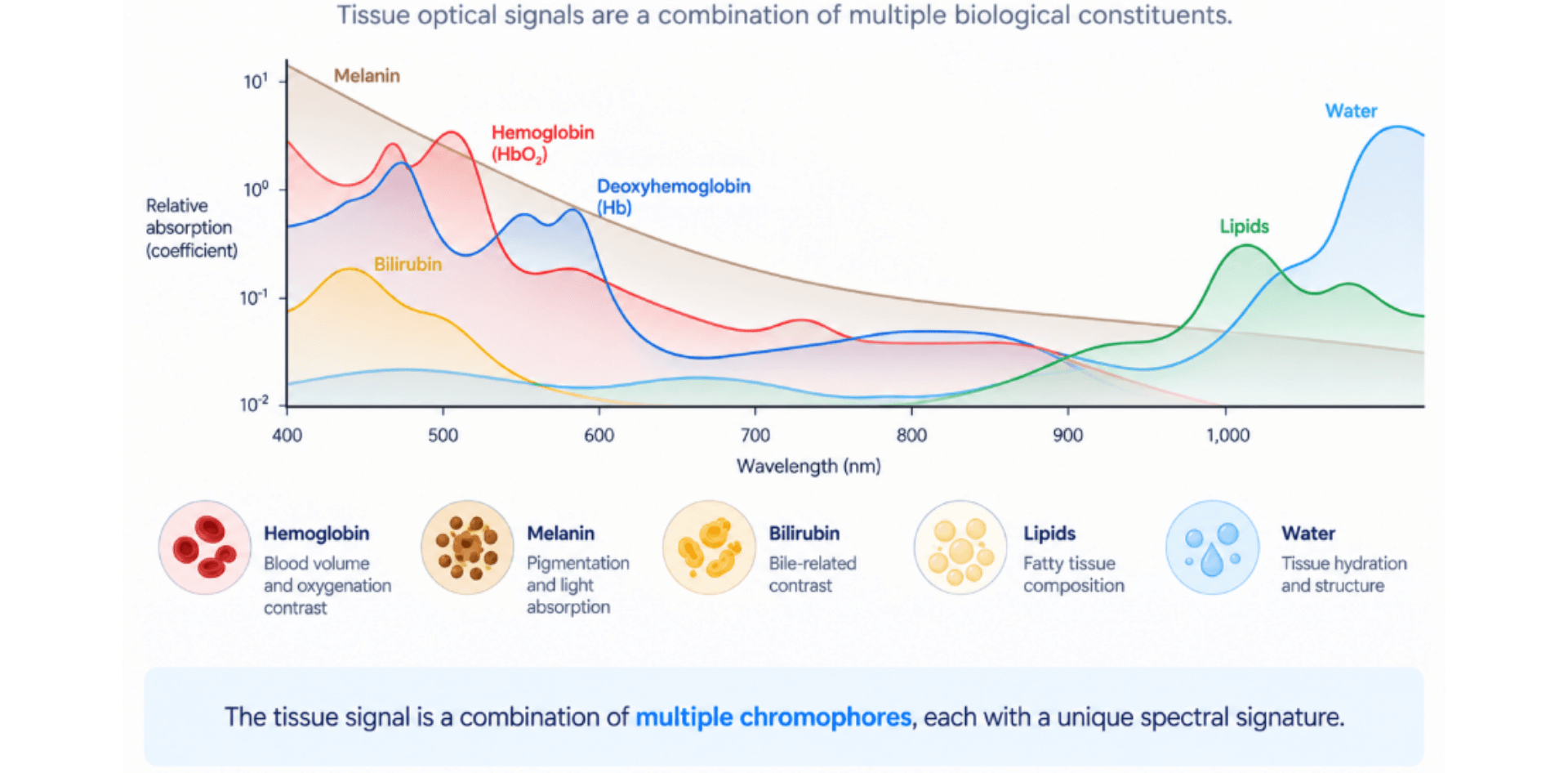
Biological tissue is not optically uniform. When light enters tissue, it interacts with molecules, cells, blood, and structural features through absorption, scattering, reflection, and transmission.
Those interactions vary across the optical spectrum. Different wavelengths can therefore produce different measurable responses from the same tissue. Multispectral imaging uses those wavelength-dependent differences as information.
Absorption, scattering, and optical path
Absorption: different tissue constituents absorb different portions of the spectrum, creating measurable contrast between tissues or structures.
Scattering: not all light is absorbed. Structures within tissue redirect light in wavelength-dependent ways, adding information beyond absorption alone.
Optical path and penetration: as light propagates, repeated scattering and absorption produce complex, wavelength-dependent effective path lengths - creating opportunities to interrogate structures at different effective optical depths.
Light returning to a detector can include surface reflection, diffuse reflectance, backscattered light, and wavelength-dependent absorption. Those responses can carry information about composition, structure, and anatomy.
Illumination and the sensor are part of the measurement
The information available to an imaging system depends not only on what the sensor can detect, but also on what the tissue is illuminated with. Controlled, spectrally separated illumination can selectively generate measurable optical responses that may not be available under conventional broadband light.
Detection architectures must also match the objective - spectral sensitivity, quantum efficiency, noise, dynamic range, and spatial resolution all influence what can be recovered.
Illumination is not merely about making tissue visible. It is about creating measurable information.
From optical phenomena to information
Light interacts with tissue. Tissue modifies the light. Sensors capture those changes. MSI turns those changes into information - the foundation for processing, algorithms, visualization, and intelligent interpretation.
See how EPMD assembles this science into the BioMIS™ stack, and what MSI can reveal in practice, on the BioMIS technology page.
Par Rohan Nagare